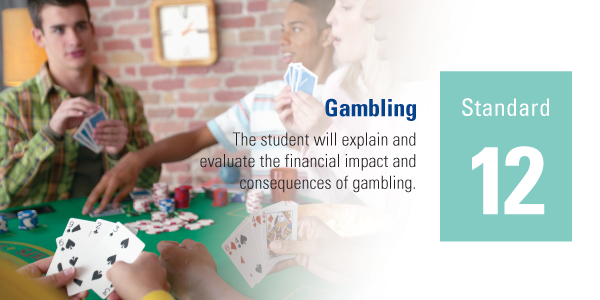
Standard 12: Gambling

PFL 12.1 Identify common types of gambling available to consumers and explain the probabilities of winning at games of chance.

PFL 12.2 Evaluate the impact of gambling on the economic development of local, tribal, and state communities, including revenue, employment, and tourism.

PFL 12.3 Analyze the costs of gambling on individuals and society (e.g., financial situation, addictive behavior, and missed work).

Teaching Resources

Oklahoma State Department of Education: Making $en$e: Financial Success Curriculum and Frameworks –  | view now

Lessons, Activities, Calculators and Videos:

  • Lesson and Acitivty Series – Beyond the Bet: Economics of Gambling – NAEE Gold Curriculum Award | view lessons

  • Lesson: Risky Business in Teen Gambling – Econedlink.org  | viewnow
  • Lesson: Rolling the Dice – Betting with your Future Self – FEE | view now
  • Video and Response: Exposing the Gambling Epidemic – Financial Times Classroom Edition – FEE | view now
  • Video/News Story: Teens and Gambling Addiction – Good Morning America | view now
  • Lesson: An Investment in March Madness (with slides and video) – FEE | view now

PFL 6.1 Analyze the necessity of planning and saving for retirement.

A. Identify costs of retirement such as living expenses, health care, and long-term care, based on life expectancy.
B. Explain how beginning to save or invest at different stages of life or over different periods of time significantly impact financial preparedness for retirement.

PFL 6.2 Evaluate various sources of income for retirement.

A. Compare government and employer-sponsored retirement plans, such as Social Security and 401(k) accounts.
B. Identify various personal investments, such as IRAs, and describe how they can provide financial resources for retirement.
C. Explain that entrepreneurs and self-employed individuals may be responsible for generating their own retirement income, as opposed to government or employer- sponsored plans